Facing rising electricity bills and wanting to make a smart choice for your home cooling? When it comes to ceiling fans, the decision often boils down to two core technologies: AC (Alternating Current) and DC (Direct Current) motor fans. While both effectively circulate air, understanding their fundamental differences, especially regarding energy consumption, is crucial for making an informed investment that impacts both your comfort and your wallet. This guide will demystify AC and DC motor fans, offering a comprehensive comparison to help you choose the ideal fan for your needs and maximize your energy savings.
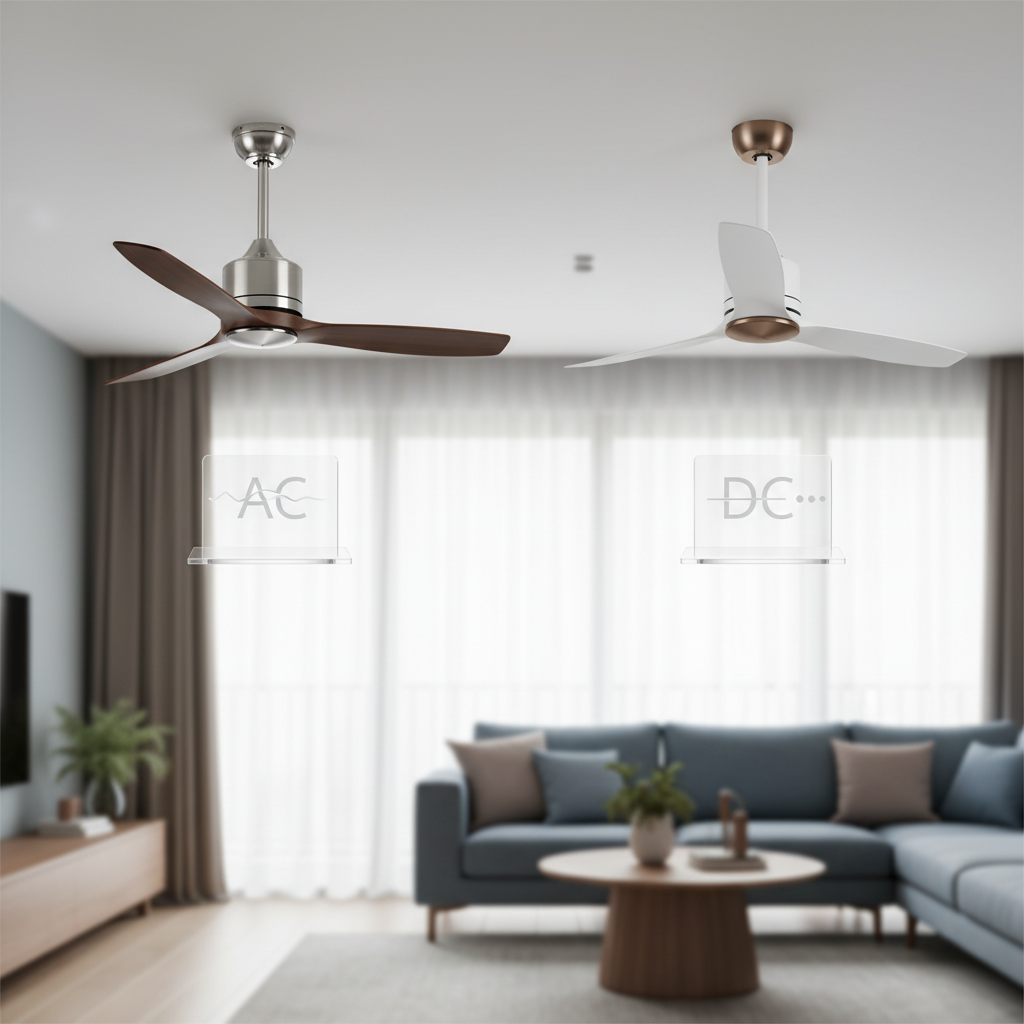
Understanding Ceiling Fan Motors: AC vs. DC Explained
Before diving into performance specifics, it’s essential to grasp how AC and DC motors operate. This foundational knowledge illuminates why one typically excels in energy efficiency over the other.
What are AC (Alternating Current) motors?
AC motors are the traditional workhorses of ceiling fan technology, having powered homes for decades. They operate directly on the alternating current supplied by your home’s main electrical grid. This current constantly changes direction, and AC motors use this fluctuating power to generate the electromagnetic force that spins the fan blades. Known for their simplicity and robustness, AC motors have been a reliable choice, often controlled by a pull chain or a wall switch, and typically offer a limited number of speed settings, usually three to five.
What are DC (Direct Current) motors?
DC motors represent a newer, more advanced approach to fan technology. Unlike AC motors, DC motors don’t draw power directly from the alternating current supply. Instead, they incorporate an internal transformer or inverter that converts the incoming AC power into direct current. This conversion allows for far more precise control over the motor’s operation. DC motors utilize permanent magnets and electromagnets to create rotation, leading to smoother, quieter, and significantly more efficient performance. They are often associated with modern designs and advanced control features.
Energy Efficiency Showdown: AC vs. DC Power Consumption
When it comes to reducing your energy footprint and utility costs, the energy consumption of your ceiling fan motor is perhaps the most critical factor. DC motor fans lead the pack in this regard, offering substantial savings.
DC ceiling fans are remarkably more energy-efficient, often consuming up to 70% less electricity compared to AC fans of the same size and operating speed. While a traditional AC fan might draw between 60 to 100 watts at its highest speed, a DC fan typically requires a maximum of around 35 watts for high-speed operation, and can operate on as little as five watts at lower settings. This significant disparity in power usage translates directly into noticeable reductions on your electricity bills over time, making DC fans a savvy, long-term investment. This superior efficiency also means a smaller environmental impact, contributing to a lower carbon footprint for eco-conscious consumers.
Beyond Energy: Key Differences in Performance and Features
While energy savings are a primary motivator, the advantages of DC motor fans extend well beyond just lower electricity bills. They often offer a superior user experience in several other key areas, from acoustics to aesthetics.
Noise Levels: A Silent Revolution with DC Fans
|
Our Picks for the Best Ceiling fan in 2026
As an Amazon Associate I earn from qualifying purchases.
|
||
| Num | Product | Action |
|---|---|---|
| 1 | addlon Ceiling Fans with Lights, 42 Inch Low Profile Ceiling Fan with Light and Remote Control, Flush Mount, Reversible, 3CCT, Dimmable, Quiet, Black Small Ceiling Fan for Bedroom Indoor/Outdoor Use |

|
| 2 | Asyko 46" Low Profile Ceiling Fan with Light and Remote Control,Black Modern Flush Mount Ceiling Fan with Lights for Bedroom, Reversible, Dimmable, Noiseless |
|
| 3 | ZMISHIBO 52 Inch Ceiling Fan with Light, App&Remote Control, Flush Mount Low Profile, Dimmable 20W LED Light, Quiet Reversible Motor for Bedroom, Living Room, Apartment, Black |
|
| 4 | ZMISHIBO Ceiling Fans with Lights and Remote, 19.7'' Low Profile Ceiling Fan, 3000-6000K Dimmable Modern Flush Mount LED Fan Light, 6 Wind Speeds, Black Fandelier Ceiling Fans for Bedroom |
|
| 5 | Passky Ceiling Fans with Lights, 52 inch Sleek Ceiling Fan with Light and Remote Control, 3CCT, Dimmable, Reversible, Noiseless, Black Ceiling Fan for Bedroom, Living Room |
|
| 6 | Fanbulous 52 Inch Ceiling Fans with Lights and Remote, Stepless Color Temperature Change & Dimmable 20W LED Ceiling Fan, 6 Speeds Reversible Quiet DC Motor for Bedroom, Living Room, Apartment, Black |
|
| 7 | Ceiling Fans with Lights, 52 Inch Modern Ceiling Fans with Lights and Remote Control, DC Reversible Motor, Noiseless, 3CCT, Ceiling Fan for Bedroom, Living Room, Apartment Indoor/Outdoor Use |
|
| 8 | Ceiling Fans with Lights, 42 Inch Ceiling Fan with Light And Remote, 3CCT Flush Moun Low Profile Ceiling Fans, 6 Speed Noiseless LED Ceiling Fan, Black Ceilings Fan with Remote for Bedroom Living Room |
|
| 9 | Ceiling Fans with Lights - 42 Inch Low Profile Ceiling Fan with Light and Remote, Reversible DC Motors, 3CCT Dimmable Timer Noiseless, Black Flush Mount Ceiling Fan for Bedroom/Living Room |
|
| 10 | Amico Ceiling Fans with Lights, 42 inch Low Profile Ceiling fan with Light and Remote Control, Flush Mount, Reversible, 3CCT, Dimmable, Noiseless, Black Ceiling Fan for Bedroom, Indoor/Outdoor Use |
|
One of the most appreciated benefits of DC motor fans is their incredibly quiet operation. Thanks to their advanced motor design and reduced mechanical friction, DC fans operate almost silently, even at higher speeds. This makes them an ideal choice for bedrooms, nurseries, home offices, and other spaces where a peaceful ambiance is paramount. In contrast, AC fans, particularly at higher settings, can produce more noticeable motor hum or blade noise, which can be disruptive in quiet environments.
Control and Speed Options: Precision at Your Fingertips
DC motor fans provide unparalleled control over airflow and comfort. They typically offer a wider array of speed settings, often ranging from 6 to 9 or even more, compared to the more limited 3 to 5 speeds usually found on AC fans. This allows for a much finer tuning of the airflow to suit specific comfort levels throughout the day. Furthermore, DC fans often come standard with advanced features such as remote control operation, quick response to command changes, and a convenient reverse function that can be easily activated via the remote to switch between summer and winter modes.
Design, Weight, and Installation
The compact size of DC motors also influences fan aesthetics and installation. DC motors are significantly smaller and lighter than their AC counterparts. This allows manufacturers greater flexibility in design, leading to sleeker, more modern, and often more minimalist fan styles that seamlessly integrate into contemporary interiors. The lighter weight also simplifies the installation process, placing less strain on ceiling mounts. AC fans, with their bulkier motors, can sometimes be more limited in their design versatility.
Durability and Maintenance
With fewer moving parts and efficient operation that generates less heat, DC motors generally boast a longer lifespan and require less maintenance compared to AC motors. This enhanced durability contributes to the long-term value of a DC fan, reducing the likelihood of premature wear and tear and the associated repair costs.
AC vs. DC Motor Fans: A Comparative Table
To simplify your decision-making process, here’s a quick overview of the key differences:
| Feature | AC Motor Fans | DC Motor Fans |
|---|---|---|
| Power Source | Alternating Current (direct from mains) | Direct Current (AC converted to DC via transformer) |
| Energy Usage | Higher (e.g., 60-100 watts at high speed) | Significantly Lower (e.g., 5-35 watts at high speed) |
| Energy Savings | Standard | Up to 70% more efficient |
| Upfront Cost | Generally Lower | Generally Higher (but decreasing) |
| Running Cost | Higher | Significantly Lower |
| Noise Level | Can be noisier, especially at high speeds | Whisper-quiet |
| Speed Settings | Limited (e.g., 3-5 options) | More (e.g., 6-9+ options), precise control |
| Control | Wall control common, optional remote | Remote control standard, advanced features (reverse, smart) |
| Motor Size | Bulkier | Compact, lighter |
| Design | Traditional | Sleek, modern, versatile |
| Lifespan | Good, but potentially more wear and tear | Longer, less maintenance |
The Cost Factor: Upfront Investment vs. Long-Term Savings
When evaluating AC vs. DC motor fans, the cost is a significant consideration. AC fans typically come with a lower initial purchase price, making them a more budget-friendly option upfront. However, the advanced technology within DC fans usually translates to a higher initial investment.
It’s crucial to look beyond the sticker price and consider the total cost of ownership. The substantial energy savings offered by DC fans, often up to 70% less power consumption, can significantly offset their higher upfront cost over the fan’s operational lifespan. In regions with high electricity rates or for fans that run for many hours daily, the long-term savings from a DC motor fan can quickly make it the more economical choice. As technology advances, the price gap between AC and DC fans has also been narrowing, making DC options increasingly accessible.
Which Motor Fan is Right for You? Making an Informed Choice
Deciding between an AC and DC motor fan ultimately depends on your priorities, budget, and specific needs. Both types offer effective air circulation, but they cater to different preferences.
Choose an AC motor fan if:
- You are primarily concerned with a lower upfront purchase cost.
- You prefer simpler, more traditional controls (like a pull chain or basic wall switch).
- Noise levels are not a major concern for the intended installation area.
- You are replacing an existing AC fan and want a straightforward swap.
Choose a DC motor fan if:
- Energy savings are a top priority. The long-term reduction in electricity bills can be substantial.
- Quiet operation is essential, especially for bedrooms, studies, or living areas where noise can be distracting.
- You desire precise control over fan speed and advanced features like remote-controlled reverse functions or smart home integration.
- You appreciate modern, sleek fan designs and lighter fixtures for easier installation.
- You are willing to invest more initially for a more energy-efficient, durable, and feature-rich product.
Consider the size of your room, how often the fan will be used, and your personal comfort preferences. For continuous comfort and significant savings over time, a DC motor fan is typically the superior choice.
In the world of ceiling fans, the evolution from AC to DC motor technology has ushered in a new era of energy efficiency, quiet performance, and advanced control. While AC fans remain a reliable and more affordable upfront option, DC motor fans shine with their ability to drastically cut electricity consumption, operate with whisper-quiet serenity, and offer unparalleled precision in airflow management. The best choice hinges on balancing your immediate budget with your desire for long-term savings, enhanced comfort, and sophisticated features. By understanding these distinctions, you are now equipped to make a confident decision that will keep your home comfortable and energy-efficient for years to come.
Frequently Asked Questions
What is the primary reason to choose a DC motor fan over an AC motor fan?
DC motor fans are primarily chosen for their superior energy efficiency, consuming up to 70% less electricity, and their whisper-quiet operation, making them ideal for spaces where minimal noise is desired.
Are DC ceiling fans more expensive than AC ceiling fans?
Yes, DC ceiling fans generally have a higher upfront cost due to their advanced technology. However, their significant energy savings often lead to a lower total cost of ownership over the fan’s lifespan, making them a wise long-term investment.
Do DC fans offer more speed options?
Yes, DC fans typically offer a wider range of speed settings, often 6 to 9 or more, providing greater control and precision over airflow compared to AC fans, which usually have 3 to 5 speed options.
How much quieter are DC fans compared to AC fans?
DC fans operate almost silently due to their advanced motor design and reduced mechanical friction, making them noticeably quieter than most AC fans, especially at higher speeds, where AC fans can produce more audible noise.
Can AC and DC motor fans be controlled by smart home systems?
While some newer AC fans may offer smart control options, DC fans are more commonly integrated with advanced features like remote controls, multiple speed settings, and compatibility with smart home systems, offering greater flexibility and modern convenience.